
Why Do Home Improvement Businesses Keep Losing Money to Hidden Wastage?
As an owner of a growing home improvement business, you’ve likely built something you are proud of, a company that delivers quality craftsmanship and stands behind its work. That separates you from the “Chuck in a truck” competitors who undercut prices and disappear when problems arise.
However, you know that competition is fierce. As a result, you have been relentless about optimizing your installation crews, negotiating better material costs, and refining your sales scripts. Unfortunately, while you have been highly successful in all of those pursuits, there are three hidden wastage points not on your job sites that are outside of your view.
The fact that you don’t know what these are is not your fault. They are basically invisible to the average business owner because you are focusing on the things in front of you: the leads coming in, the contracts being signed, and the projects being built. The fact is, knowing and fixing these hidden wastage points is critical to your bottom line and in many cases your survival.
Knowing this devastates me and is why I am going to outline exactly what these three hidden wastage points are and exactly what you need to do to rectify them.
Siloed Decisions
The number one issue I see devastating home improvement companies is when owners burn their budget on siloed metrics. What is a siloed metric, you say? In short, it’s when an organization focuses on fixing a single metric in one department that blows up a far more important metric within another. I’ve seen this issue present itself often within companies that pride themselves on being “data driven”. Yet the results are stressed-out staff and an even more stressed-out owner.
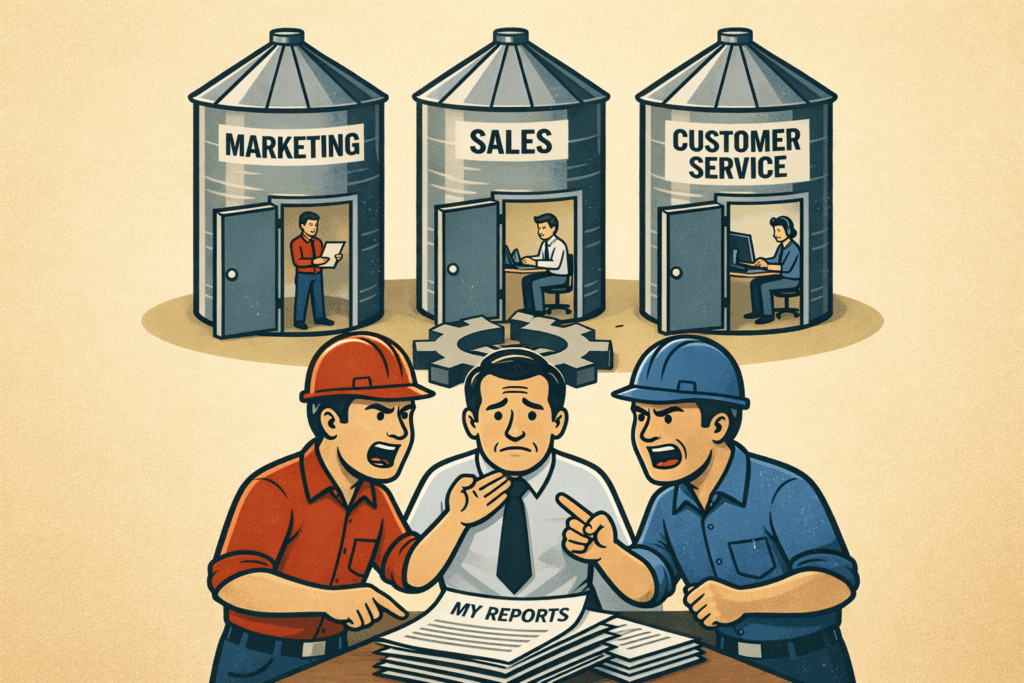
The best solution to this is to understand your top-level goal, usually increasing profitability, and to create a hierarchy of metrics that supports that goal. This tells your team that they can fix any metric in your organization as long as it doesn’t drastically hurt another more important one, like closure rate.
Derek was a great example of just that. As a key leader at a high-volume bathroom remodeling business, he took pride in the fact that they were growing like a weed, outgrowing their facility in record time. He felt a deep personal responsibility to ensure the sales and call center teams were performing at their peak to support the families of the dozens of additional employees they had hired.
Unfortunately, Derek was confronted by a staggering increase in his customer acquisition cost. The marketing team was cutting ‘expensive’ channels to get a ‘low cost per lead’. Meanwhile, sales was freaking out because their closure rates were plummeting. Derek was left with the chronic stress of two teams scrambling to find any answers to the problem, without any clear solutions.
On our first call Derek quickly realized what had happened. The marketing team fixated on ‘low cost per lead’ and it sent sale’s closure rate into freefall. Derek was amazed that focusing on a seemingly good metric led to such a large downstream impact on closure rate and by extension customer acquisition cost. Derek sprang into action implementing a metric hierarchy, making it clear which metrics mattered towards the ultimate goal of profit.
This change allowed Derek to turn things around and get back to the business growing like a weed, so much so that he had to add an additional three employees in the next four months.
Home improvement owners often suffer from siloed decisions that lead to hidden wastage. Learn from Derek’s example and create a clear hierarchy of metrics that you can communicate to your team. He reaped the benefits of everyone pulling in the same direction putting additional profit directly into his back pocket.
The Data Hamster Wheel
Imagine a business owner, pacing the floor at midnight, buried under a mountain of Excel tabs, running a high-speed marathon that leads nowhere. Data promised answers but instead, it created a Hamster Wheel. More manual updates. More copy-pasting. More late nights. And less clarity. It’s an addiction to “motion” that masquerades as “progress.” While the next hit of manual data entry feels like you are finally “getting a handle” on the numbers, you are actually just spinning the wheel faster, tethered to a desk when you should be leading your team. The tragedy? The insights that could save you are usually hiding in plain sight—ignored, underutilized, and lost in the avalanche of manual spreadsheets you and your managers endure daily.
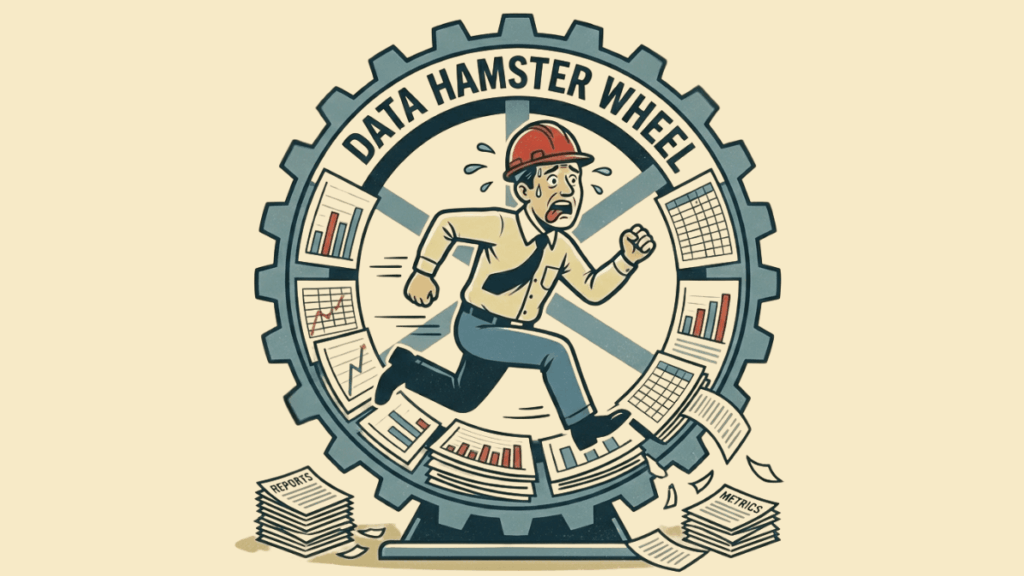
This may seem counterintuitive, but the answer isn’t “more reporting”; it’s knowing which data is your North Star. Instead of spinning the wheel just because you can, ask: What decision will this help me make? If you don’t have a clear answer, cut it. Focus only on the data that serves a purpose. Cris’s story is a perfect example of this.
When we first met Cris, he was running a home services powerhouse, but beneath the surface, Cris was exhausted. Despite his massive success, he was still the primary “motor” for his company’s data, running on the data hamster wheel—manually moving data from Lead Perfection into custom spreadsheets just so his sales managers could see their numbers.
On our very first call, it hit him. Cris realized he had fallen deep into the trap, he was an owner doing the work of a data entry clerk. He admitted on the call:
“I’m guilty of getting in there… I wanted to do this crap. [But I realized] it’s a laborious task.”
He had been seeking control through the manual process, telling himself he needed to “get in the weeds” to understand the numbers. But this need for control had blinded him to the truth. Instead of leading the company, he was making snap decisions based on “laborious” manual calculations, effectively becoming the bottleneck for his own team’s intelligence.
To break free, he started asking a simple but powerful question: What goal does this data actually support? Equipped with this new mindset, he went to work slashing meaningless data. With the now streamlined reports he was able to “institutionalize” his calculations he was doing manually at midnight and coded them into an automated system. Eliminating the manual “hoard” of data allowed him to finally see the real bottlenecks in his call center and refocus his effort on lead response times.
Today, Cris has his life back. His managers get live updates without him lifting a finger, and the business continues to skyrocket because the owner is finally back in the owner chair. He felt the relief of knowing he no longer had to be the bottleneck for his own company’s intelligence.
You’d never allow physical waste, like discarded siding or roofing scraps, to build up and slow down your job sites. Yet many businesses allow “data waste” through unnecessary reports to pile up, keeping the owner trapped on the wheel. Before you perform one more manual data update, ask yourself: What goal does this data actually support? Break the wheel and focus on what actually moves the needle.
Skewed Conclusions
The worst pain for an owner isn’t when a project fails—it’s when you have 100% confidence that you’re winning, only to realize your conclusion was built on a lie. We call this Skewed Conclusions. In the home improvement world, this happens when you trust a report simply because it came out of a “reputable” piece of software, without realizing that the software is only giving you a fraction of the truth.

You look at a dashboard provided by your CRM, you see a green arrow, and you make a high-stakes decision to spend another $10,000 on marketing. But because that report doesn’t account for the “math across the departments,” your conclusion is skewed. You are celebrating a “win” in the CRM that is actually a “loss” in the bank account. Kim’s story highlights exactly how easy it is to fall into this trap.
Kim’s team used industry-standard software like Lead Perfection and QuickBooks. She also had managers who were hungry for data. Because the software was powerful, there was a high level of confidence in its output. As Kim noted, her managers would “just click a button, it’s a report”
The problem? They were mistaking availability for insight. They were confident in these “canned” reports, but they were often pulling lists of data instead of strategic insights. They were looking at a “Call Center Result” report in a vacuum, concluding that the team was performing well because the report said so. However, on our call Kim realized when she dug deeper, they weren’t showing the lead response time or connecting it to the ultimate net sale. By relying on what the software gave them out-of-the-box, they were essentially getting half the story.
Revolted, Kim realized that to get to the truth, she had to stop being a passive consumer of “canned” data and start getting the full picture. The skewed conclusions vanished. This holistic view led to creating a new inbound marketing practice that made leads 3x more likely to close.
If you are making decisions based on reports just because they are easy to “click a button” and generate, you are likely operating on skewed conclusions. You owe it to your business and your family to move past the canned reports and start connecting the pieces. Only then can you have true confidence that your “wins” are actually showing up in your bottom line.
Conclusion
As a home services business owner, I want you to know that the world needs your commitment to quality, and more importantly, your community needs you to grow. You aren’t just installing roofs, siding, or kitchens; you are providing the stability of local jobs and the peace of mind that comes with high-quality craftsmanship.
But the truth is, unless you put an end to these hidden wastage issues—the Siloed Decisions, the Data Hamster Wheel, and the Skewed Conclusions—by giving them the same attention as your job sites, you are giving your competitors the leg up they need to win. You cannot afford to let “Chuck in a truck” or fly-by-night operations undercut you simply because your profit is leaking through invisible data gaps.
We won’t let that happen. If the advice from this article didn’t give you the answer you need to win the war against your competition, then click here to schedule a free call with us. We’d be honored to assist you with some customized, free guidance so you can continue to serve the communities you support so well.
Oh, and if you found this was the article you needed to read today, please share it with another home services business owner who is working hard to build something that lasts.